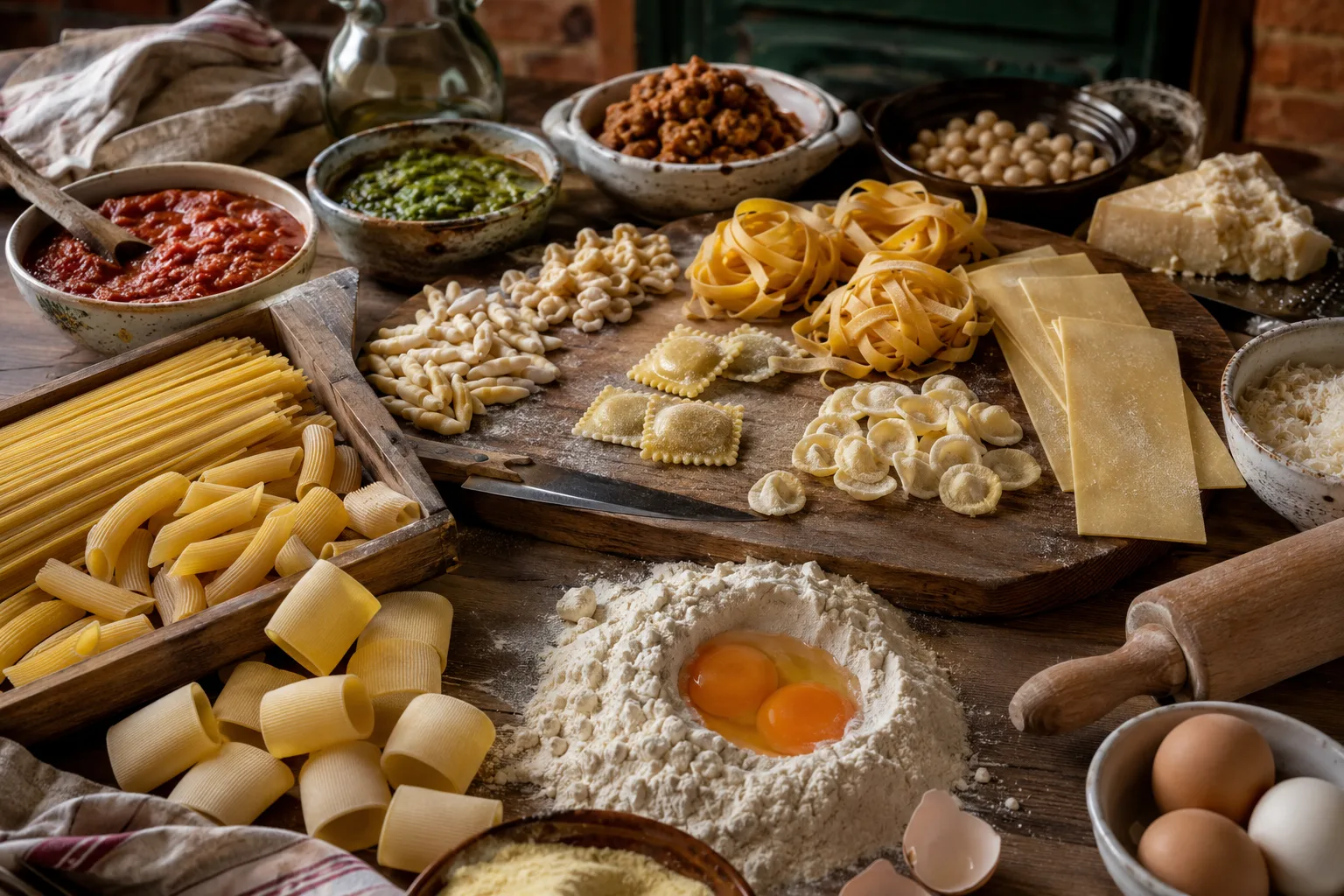
Treccani’s entry on Pasta alimentare notes that there are several dozen common shapes, while a historical estimate reaches more than six hundred; the same shape may also bear different names from one region to another. This variety is therefore not a matter of decorative whim. A tube, a ribbon, a spiral and a small hollow each create a different relationship between surface, weight and sauce. Treccani observes that these differences affect how sauce spreads and help us perceive pasta made from the same dough, even by the same producer, in different ways [1].
A more useful question is this: if spaghetti, penne and rigatoni often share the same ingredients, why does replacing one with another change the dish? The answer begins with the material itself. As pasta cooks, water enters it, gradually softening its structure and changing starches and proteins; thickness, cross-section and surface determine how quickly this happens and how the mouthful responds under the teeth. Research on pasta quality looks precisely at such factors as firmness, elasticity, adhesiveness and loss of solids in the cooking water [2].
A shape does not decide on its own whether a recipe succeeds. Wheat, drying, the frying pan, starchy water, the thickness of the sauce and timing all matter. But shape directs the rest. A broad pasta spreads a ragù along a strip; a hollow gathers pieces of vegetable, cream or cheese; a small pasta fits into a spoon with broth. Italian variety starts here: in the effort to make one food work well in very different kitchens, seasons and ways of eating [2].
Dough before shape
Talking only about shapes leaves out half the story. An egg tagliatella and a semolina spaghetti are not alternative drawings: they have different moisture levels, elasticity, methods of preparation and uses. Dried semolina pasta, made from water and durum wheat, has a structure that withstands drying, transport and long storage. Fresh pasta retains more moisture, needs to be eaten sooner after it is made, and often belongs to domestic, artisanal or trattoria cooking. Egg dough has a different suppleness, making it suitable for ribbons, lasagne and wrappers for fillings [2].
| Type |
Characteristics |
Practical and historical use |
| Dried semolina pasta |
Water, semolina, drying |
Storage, trade, everyday cooking |
| Fresh pasta |
Higher moisture, eaten soon after preparation |
Homes, small shops, trattorias, special occasions |
| Egg pasta |
Softer, more workable dough sheet |
Tagliatelle, lasagne, filled pasta |
| Filled pasta |
Dough sealed around a filling |
Broths, celebrations, family meals |
| Small pasta shapes |
Small, quick-cooking pieces |
Soups, pulses, broths |
The research of Andrea Bresciani, Maria Ambrogina Pagani and Alessandra Marti describes pasta-making as a sequence of dosing, mixing, shaping and drying. For traditional dried pasta, durum-wheat semolina remains the reference ingredient, but the final quality also depends on correct hydration, extrusion or sheeting, and the management of drying [2]. Shape comes at the end of that process and carries its traces.
An extruded shape passes through a die: penne, rigatoni, tubetti and many fusilli can be made this way, with speed and regularity. Rolled dough, by contrast, is worked with a rolling pin, roller or machine and then cut, folded or sealed. In home kitchens, even simpler gestures survive: a small piece of dough dragged across a board, pressed with a thumb, wound around a rod or marked with a knife. Each gesture creates a surface and a texture. Before deciding which sauce is “right”, it helps to ask what dough and what hand produced the shape [6].
Geographies of wheat
Italy did not develop a single pasta cuisine because it never had one climate, one agricultural market or one way of processing wheat. Massimo Montanari urges us to distinguish administrative regions from the real territories of food culture: cities, valleys, coasts, plains, mountains and trade routes have often mattered more than boundaries drawn on maps. Recipes and local products travelled, influenced one another and retained different names even when their kinship was obvious [3].
In southern and coastal areas, where durum wheat and drying enjoyed favourable conditions, many traditions of dried semolina pasta became established. In Emilia-Romagna, Piedmont, Lombardy and parts of central Italy, rolled egg dough and fillings have long carried considerable weight in home cooking and festive meals. Alpine and border areas also tell stories of buckwheat, potatoes, chestnuts and mixed doughs. These are not sealed compartments: tagliatelle can be found in the South, dried pasta in Piedmont and filled pasta in many southern cities. Generalisations are useful only as a first orientation [4].
Italia.it accordingly presents pasta shapes as a journey through different traditions: spaghetti and tonnarelli, pizzoccheri, canederli, lasagne and other local doughs. The list brings together foods that do not all have the same technical meaning, yet it conveys the plurality of the Italian table [4]. Geography helps explain why pasta can be a durable commercial product, a gesture made in the morning for lunch, a spoonable soup or an oven dish designed for a crowd.
Place continues to matter after wheat has been harvested. It affects which fats are common, whether broths or olive oil are used more often, which vegetables arrive in season, and the place occupied by fish, pulses, cheese or meat. A shape born to gather a vegetable sauce may later travel and meet a different dressing. Tradition does not stand still, but it retains the memory of the conditions that created it. That is why a pasta shape cannot be reduced to a compulsory pairing printed on the back of a packet [3].
Threads, ribbons and tubes
Long pasta is a much wider family than spaghetti alone. There are fine strands, thicker strands, flat ribbons, rippled ribbons, long tubes and shapes twisted like a helix. Treccani distinguishes precisely these groups: spaghetti, vermicelli and capellini; fettuccine, tagliatelle and linguine; ziti and maccheroni; fusilli, lasagne and other ribbons. The classification is more than a catalogue: it shows how the profile of a shape changes cooking and the distribution of sauce [1].
Spaghetti work well when the sauce remains fluid or moderately clinging. Oil emulsified with cooking water, a simple tomato sauce, clams, or a fish sauce with few large pieces accompany the strand without breaking its rhythm. With a very dense ragù, the result may still be enjoyable, but the meat tends to spread less evenly than it does on broad, rough or hollow pasta. No rule has been broken: each forkful is simply assembled in a different way [1].
Linguine and bavette are flatter and have more lateral surface; pesto, herbs, oil-based emulsions and seafood sauces find a broad base without disappearing into deep hollows. Bucatini, by contrast, add a central hole: their thickness changes the bite, and the sauce can also reach the inside. Italia.it describes bucatini as thick, hollow durum-wheat spaghetti associated with Lazio, while capelli d’angelo are also used in broths and soups [11].
Tagliatelle, fettuccine and pappardelle are not merely enlarged spaghetti. Their ribbon shape lets sauce spread along the surface and better supports preparations with meat, mushrooms, butter, cheese or enveloping sauces. In Bologna, the municipal De.Co. register has recognised the association between ragù and tagliatella al ragù; the link is cultural as well as practical [8]. This does not oblige every kitchen to reproduce the same recipe, but it helps explain why a wide egg dough and a slow-cooked sauce grew up together.
The logic of tubes is equally clear. Penne, rigatoni, mezze maniche, paccheri and ziti provide hollows, edges and thickness. They do not hold sauce like sponges: they create points where cream, cheese, pulses, vegetables and small pieces can settle. Ridges add surface; the diagonal cut of penne makes for a clean mouthful; paccheri make the very size of the pasta part of the experience. The shape gives the sauce a framework, then the pan decides whether the encounter works [1].
The work of the hands
Many regional pastas tell the story of a technique before they tell the story of a recipe. Cavatelli, orecchiette, trofie, fusilli al ferretto, pici, bigoli, strangozzi and chitarrine carry, in their names or forms, a repeated gesture: dragging, hollowing, twisting, pulling, passing dough through metal wires. An industrial die can reproduce some profiles precisely, but it does not erase the manual logic that brought them into being [6].
Orecchiette provide a clear example. Their hollow gathers small ingredients, while the thicker rim keeps a different resistance from the centre. The tourism website of the Puglia Region identifies durum-wheat semolina as their main ingredient and recalls the handwork still practised in the lanes of Bari Vecchia [5]. Pasta with cime di rapa is their best-known pairing, but the shape has also accompanied ragù, vegetables, crumbs, ricotta forte and pulses. One famous recipe does not exhaust what the shape can do.
With trofie, the twist creates an irregular surface that works especially well with pesto. Technique and place operate together: Ligurian pesto has basil, olive oil, cheese and nuts, as well as a distinctive consistency; trofie offer ridges and turns across which that sauce can spread. The Liguria Region still presents trofie al pesto among the specialities of its local tradition [9]. To say that one “requires” the other would simplify too much, but their meeting has recognisable historical roots.
The Accademia Italiana della Cucina recalls how strongly regional fresh pasta depends on the hands that knead it, listing a wide family of shapes: fettuccine, lasagne, trofie, bigoli, maltagliati, pici, cavatelli and orecchiette. It also notes that local products have enriched doughs and fillings, sweet and savoury alike [6]. This is a useful antidote to the idea of an Italy made up of rigid formulas. Hands work with what is available, repeat a technique, alter a measure and turn everyday food into a local sign.
Pasta for the spoon
Pasta was not created solely to be sauced and wound around a fork. Ditalini, tempestine, stelline, anellini, risoni, semini and small tubetti belong to the cooking of the spoon. They cook quickly, enter broth without taking over the dish, accompany pulses and vegetables, and allow cooks to use scraps of dough or small quantities left in the cupboard. These shapes belong to ordinary suppers, children’s food, convalescence, canteens and homes where a soup had to feed many people with little [1].
Their size changes the relationship with the other ingredients. In a chickpea or bean soup, pasta that is too large would separate the mouthful; ditalini can instead fit into the spoon with both broth and pulses. The same applies to vegetable soup: the pasta adds substance and calories, while allowing the liquid to remain at the centre of the dish. Treccani includes small tubes, rings, stars, letters and other tiny shapes among cut pasta: variety concerns ways of eating as well as the appearance of the table [1].
A volume by the Accademia Italiana della Cucina devoted to reuse describes pignata di maggio, a soup of pulses and cereals that also gathered small amounts of dried pasta in different shapes or offcuts of fresh pasta. The name changed from place to place, and the ingredients depended on what was left in the pantry [7]. The case points to a simple fact: many shapes were not made to impress. They were practical, economical, easy to distribute through liquid and useful for wasting nothing.
This part of pasta’s history receives less attention than stuffed paccheri or tagliatelle al ragù, yet it says a great deal about Italian food. The small shape leaves room for broth, pulses and vegetables; it turns a modest preparation into a complete dish. At the table, pasta may take the lead, lend support or connect the other ingredients. Size decides that too [7].
Layers and fillings
Lasagne, cannelloni, conchiglioni, anelletti al forno and stuffed paccheri follow a different logic from pasta served directly from the pan. They must withstand a second cooking, absorb moisture, support sauces and cheeses, and reach the table ready to portion or divide. Lasagna is a sheet designed for layering: it alternates wet and dry elements, distributes ragù or vegetables, and gives a clean cut as it moves from baking dish to plate [6].
| Shape |
Culinary logic |
| Lasagna |
Layers, distributed moisture, cut into portions |
| Cannellone |
Protected, portioned filling |
| Conchiglione |
Visible hollow, filling, gratin finish |
| Stuffed pacchero |
Large mouthful, hollow and contrasting textures |
| Anelletto al forno |
Evenly distributed sauce and the compactness of a timbale |
Filled pasta slows the work further. Tortellini, ravioli, agnolotti, cappelletti, culurgiones, pansoti, tortelli and casoncelli need dough strong enough not to split and thin enough not to overpower the filling. In many homes, preparation involves several people: one rolls the sheet, another portions the filling, another closes the parcels and another lays them out to dry. The Accademia Italiana della Cucina links this family of pasta to manual processes and the variety of local produce, noting that fillings can be sweet or savoury, made from meat, herbs, cheese and other ingredients at hand [6].
A filling does not automatically signal abundance. In some traditions it also makes use of bread, vegetables, leftover cheese, potatoes or cooked meat. The closed shape helps give value to small quantities and offers a complete mouthful, often in broth or with a light dressing that does not conceal the work inside. Here pasta becomes a kind of domestic archive: it preserves a technique, a celebration, a seasonal ingredient and a measure passed on without scales [6].
Sauce and substance
The phrase “every shape has its sauce” contains a practical truth, but it becomes less useful when turned into law. Thickness, roughness, hollows and surface affect the way a sauce clings and reaches the palate. Treccani explicitly links differences between pasta shapes to the relationship between surface and weight, and therefore to the distribution of sauce [1]. That is enough to understand why small pasta works in broth, why a rigatone accommodates larger pieces and why a tagliatella can support a more enveloping sauce.
Food physics adds other elements. During cooking pasta absorbs water; its structure changes, the bite loses or retains resistance, and starch released into the water helps create emulsions in the pan. Bresciani, Pagani and Marti observe that hydration, shaping, extrusion pressure, drying and the quality of the semolina all affect structure and final sensory properties [2]. A sauce therefore does not meet a neutral surface: it meets pasta with a given porosity, temperature and capacity to absorb or release water.
This is why absolute rules in the kitchen are fragile. Spaghetti with ragù can be enjoyable; Bolognese tradition associates its own ragù with tagliatella, and that link has both textural and historical reasons [8]. Orecchiette with cime di rapa have an effective balance, but they can welcome other sauces. Trofie with pesto form a strong territorial pairing without excluding vegetables or fish. The choice also depends on season, what is in the house, the number of diners and the kind of dough.
A practical guide can help without becoming a court of judgement: fine strands often favour fluid sauces; ribbons and egg pastas sit well with ragù, mushrooms, butter or cheese; tubes and ridges make room for sauces with pieces; hollows and twists collect vegetable sauces, crumbs, pulses or pesto; filled pasta often needs an accompaniment that respects what is inside. The best pairing remains the one that keeps shape, sauce and cooking in balance. Tradition points to a path; it does not lock the kitchen door [1].
Industry and names
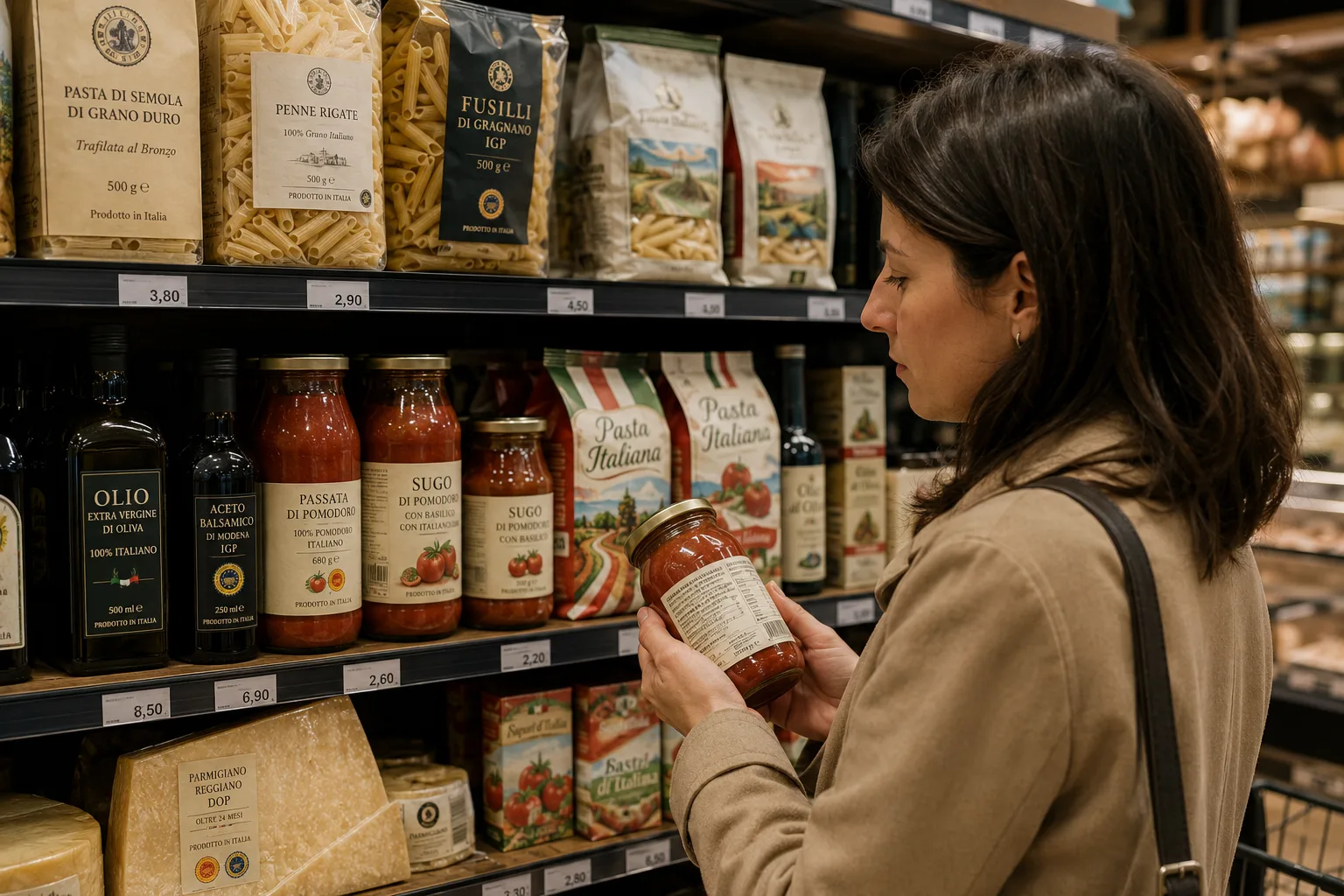
Industrial production has multiplied the presence of pasta shapes, but it did not invent all of them. Many forms born in a particular area have been standardised, extruded, dried, packed and distributed nationally or internationally. This has made trofie, paccheri, orecchiette and other regional names accessible far from the places where they became established. It has also softened some distinctions: handmade pasta may remain irregular, vary in thickness and bear the mark of the person who made it; industrial production seeks repeatability, predictable timings and resilience in transport [10].
Treccani places the start of industrial pasta manufacture around 1800 and recalls the arrival of hydraulic presses, mechanical mixers and artificial drying in the second half of the nineteenth century [10]. Technology solved concrete problems: producing continuously, reducing dependence on the weather, extending storage and moving a fragile food to distant markets. It supported pasta’s wide circulation without making artisanal knowledge irrelevant.
The name matters as much as the shape. Treccani points out that many pastas have different names according to the region [1]. Fusillo, for instance, can refer to forms and methods that are not identical; maccherone has had changing meanings; lasagna is both a sheet of pasta and, in some contexts, the assembled dish. When a local name enters mass distribution, it becomes easier to buy and easier to use as a marketing label. Sometimes a memory is preserved; at other times only an appealing Italian word remains.
Industrial pasta is not a synonym for mediocre pasta, just as handmade pasta does not by itself guarantee a better result. The quality of the wheat, dough, die, drying, cooking and sauce all matter. The real difference lies in the relationship to the shape: industry provides consistency and reach; local making preserves gestures, irregularities and timings that often cannot be fully reproduced. Both belong to the Italian history of pasta [2].
A dialect you can eat
A pasta shape can function like a culinary dialect. Its name signals origin, its gesture reveals a tool, and its usual pairing may evoke a season or a celebration. Bigoli, tajarin, busiate, culurgiones, scialatielli, pizzoccheri, strangozzi, maltagliati and maccheroni al ferretto evoke more than a form: they contain a local vocabulary and a way of being at the table. The gastronomic Italy described by Montanari lives through exchanges and circulation, yet it still recognises itself through concrete particularities [3].
This identity does not demand rigid fidelity. Recipes change, ingredients travel, families move and pairings adapt. Yet pasta holds on for a long time to what brought it into being: an available wheat, a ridged board, a rod, a die, a broth, a pot meant for many people. Even when it reaches a supermarket shelf in Germany, Czechia or Canada, the name carries part of that story with it [3].
Italian pasta shapes do not exist to make shopping harder. They are different answers to tangible questions: must the pasta keep for months, or be eaten straight away? Are there eggs, or only water and semolina? Is it served in broth, with pulses, meat, fish, cheese or vegetables? Must it feed a family on a weekday or sustain a festive table? The more than six hundred names recalled by Treccani are not a national whim. They are the outcome of many hands finding different ways to bring wheat and sauce together on the same plate [1].
Bibliography
Discussion
Join discussion!
There are already 0 comments on this article in the forum.