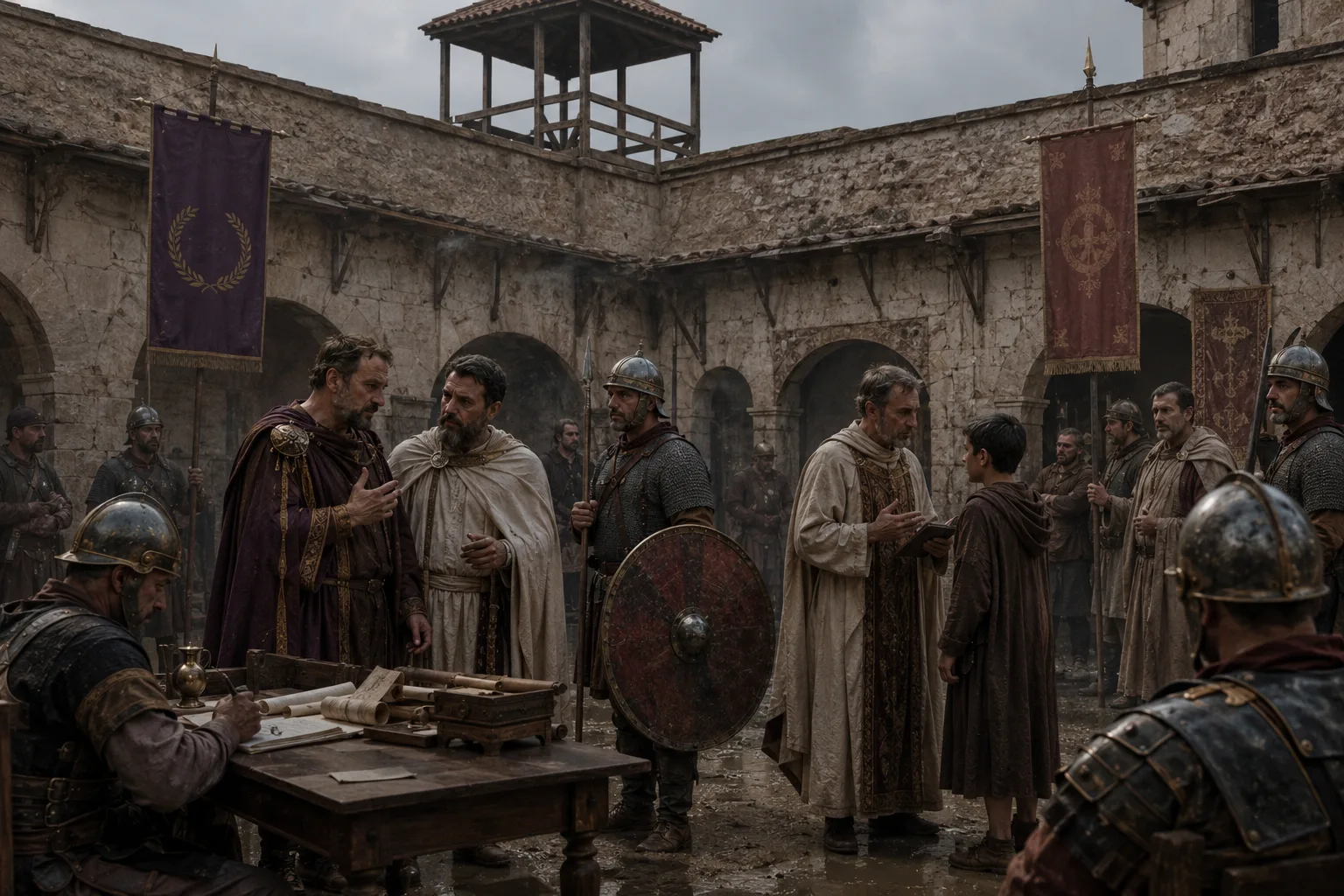
That was a genuine ending. It changed the way Italy was governed and brought a long succession of Western emperors to a close. Yet the scene bore little resemblance to the catastrophe imagined in popular memory: there was no imperial palace in flames, no crowd watching Rome’s destruction, no securely attested theatrical gesture. The imperial office had gradually lost its political substance, while armies, aristocratic families and military commanders increasingly determined who would succeed to the throne.
Even 476 is a conventional date. In a chapter published by Cambridge University Press, Guy Middleton argues that a date of “collapse” depends on what one chooses to measure: territorial loss, the effectiveness of the state, institutional continuity, imperial authority or the material conditions of the population. [2] The end of the Western Roman Empire is therefore better understood as a sequence in which military defeats, institutional ruptures and local adjustments all intertwined. The year 476 marked a highly visible political threshold; it did not switch off the Roman world overnight.
An empire already strained
The empire that came apart in 476 was not Augustus’ empire. It had been remade several times. The third century had already brought military emergencies, usurpations, pressure along the frontiers, inflation and fiscal difficulties. The reforms of Diocletian and Constantine made the state better able to mobilise people and resources, but they also increased the burden of bureaucracy, taxation and the military machine. Governing such extensive territories cost far more than it had in earlier centuries.
In late antiquity, the empire required a regular flow of income to pay soldiers, maintain fortifications, support officials, supply armies and keep routes of communication open. Each lost province reduced the resources available; each civil war forced armies to be moved and political rewards to be granted; each commander who became too autonomous could trigger another struggle for power. Treccani describes the break-up of the West as the result of a long process that had encouraged the growing regionalisation of imperial territories since the third century. [3]
This does not require an image of uninterrupted, uniform decline. The late Roman Empire still possessed considerable capacities: it administered towns, collected taxes, maintained road and sea routes, minted coinage, constructed buildings and relied on a sophisticated legal culture. But the crisis affected regions differently. The East retained major urban centres, a stronger fiscal base and provinces that remained productive. The West had less room for manoeuvre. As Gaul, Spain, Britain and Africa moved beyond direct imperial control, Italy became the centre of a state that was poorer and increasingly reliant on unstable military alliances.
The phrase “the decline of Rome” can blur these mechanisms into one indistinct story. The fifth century instead reveals very practical failures: territories ceased to send tribute, armies could no longer be paid reliably, commanders had forces of their own, and courts defended their position at home while provinces changed hands. Those fractures explain why the last emperor in the West could be deposed without provoking a military response strong enough to restore the old order.
Two Roman courts
Another misunderstanding begins with the division between East and West. After Theodosius I died on 17 January 395, the empire was governed on a stable basis by two courts: Arcadius ruled in the East and Honorius in the West. From then on, the two parts followed increasingly distinct political paths. They were not, however, two alien civilisations or two worlds suddenly divided like modern states.
Constantinople remained a Roman capital. Its emperors spoke of the res publica, preserved Roman law, governed Roman provinces and claimed authority over the empire as a whole. The West also continued to look eastwards for alliances, legitimacy, money and military support. Treccani notes that after 476 the imperial title continued in the East and the Byzantine emperor was regarded as the only legitimate Roman emperor. [4]
The division nevertheless had practical consequences. The two courts could pursue different interests, set different priorities and intervene at different speeds. When Italy and the western provinces ran into difficulty, Constantinople could not, or did not always wish to, support expensive campaigns. The West needed help, while the East had to defend the Balkans, the Danubian frontier, its relations with Persia and its own internal balance.
In 476, then, the Roman idea of empire did not disappear. The western emperor disappeared, while Zeno continued to rule at Constantinople as Roman emperor. There was even another figure who complicated the picture: Julius Nepos, deposed by Orestes in 475, retained the imperial title in Dalmatia and was recognised by the eastern court. He remained politically active until his death in 480. [5] The conventional date of 476 remains useful, but it settles neither every dynastic question nor the continuity of the eastern Roman Empire, which would survive until 1453.
Wars and frontiers
The so-called barbarian invasions are often presented as a single wave of peoples arriving from outside to destroy Rome. The image is too simple. Visigoths, Vandals, Burgundians, Franks, Huns, Ostrogoths and other groups had different origins, structures, aims and relationships with the empire. Some had long been settled in Roman provinces; some entered as federates; others fought against Rome or for Rome; several changed position more than once.
The word “barbarian” was a Roman category, often polemical. It described people outside Greco-Roman culture, but it did not identify one ethnic bloc or a uniform level of civilisation. In the fifth century, men of Germanic origin could command imperial troops, receive Roman titles, marry into elite families and become major players in internal politics. Treccani observes that many of the kingdoms called Romano-barbarian emerged through foederatio arrangements and initially continued to operate as extensions of Roman order in western provinces. [6]
The sack of Rome in 410 by Alaric’s Visigoths was an immense shock. Rome had seemed inviolable for centuries, even after it had lost some of its political centrality. The western court had already moved from Rome to Milan and then to Ravenna, which was easier to defend and closer to the Adriatic military routes. Alaric did not destroy the empire at a stroke: after 410 there was still a western emperor, a court, an administration and Roman armies. The event shook the imagination of contemporaries and made a vulnerability visible that had seemed unthinkable only decades earlier. [7]
When the Vandals entered Rome in 455, it confirmed that the city could no longer be defended as it had been. The violence was real, but it should not be transformed into the nineteenth-century myth of “vandalism” as irrational destruction. Armed groups crossing the western Mediterranean sought land, resources, political recognition and access to the machinery of Roman power. They were part of the empire’s crisis, not merely an outside force acting against it.
Rome and Africa
To understand why the Western Roman Empire never recovered, it helps to look less at the city of Rome and more at North Africa. The African provinces were among the West’s most productive and fiscally important areas. They supplied Italy with grain, generated tax revenue and provided maritime connections essential to the imperial economy.
The Vandals crossed from Spain into Africa in 429 under Geiseric. After capturing Carthage in 439, they established a kingdom that removed much of Roman Africa from imperial control. Treccani recalls that after Carthage the Vandals declared their sovereignty, while Roman authority recovered only parts of Mauretania and Numidia. [8] This was not merely the loss of a distant region: it deprived the western state of one of its principal financial supports.
Cambridge University Press summarises the effect of the conquest clearly: the Vandal kingdom threatened Rome’s grain supply and cut off tax revenues from one of the empire’s wealthiest provinces. [9] In a system funded by taxation and military expenditure, such a blow was hard to absorb. Without sufficient income, it became more difficult to pay soldiers, maintain fortifications, support a fleet, finance campaigns and keep commanders loyal.
In 468 the eastern empire and what remained of the western forces mounted a major expedition against the Vandals. Its failure was politically and financially disastrous. It did not restore Africa to Rome, but consumed resources that might have been used elsewhere. Historians still debate the causes of the West’s end: Peter Heather gives great weight to wars and migration pressures, while Bryan Ward-Perkins stresses the material consequences of collapse, visible in reduced exchange, production and quality of life. [10]
Both interpretations can coexist. An empire weakens when it loses territory; it weakens further when those territories no longer finance armies and administration. The wars were more than clashes along a frontier: they exposed a state that could no longer convert taxes, grain and manpower into political power.
The power of arms
In the second half of the fifth century, western emperors often possessed limited authority. Generals, armed guards, commanders of federate troops and personal alliances also mattered. Aetius, Ricimer, Orestes and other strongmen were not mere officials: they shaped successions, wars, political marriages and the distribution of land.
Romulus Augustulus makes the hollowing-out of the imperial institution especially clear. His father Orestes was a Roman patrician and commander of the militia. In 475 he rebelled against Julius Nepos, seized Ravenna and had his teenage son proclaimed emperor. Treccani confirms that Romulus was raised to the throne by his father and that imperial power remained substantially in Orestes’ hands. [11]
Meanwhile, the troops stationed in Italy, many of them soldiers of non-Italian origin, demanded a share of land. Orestes refused. Their demand was not simply a predatory claim: it concerned how those troops would be rewarded and incorporated into a political system that depended on them more and more. Odoacer was acclaimed by the rebels on 23 August 476; Orestes was killed at Piacenza a few days later; Romulus was deposed on 4 September. [12]
You can see here how far the empire had drifted from the stability of earlier centuries. The young emperor was not swept away in a decisive battle against an enemy from another world. He was the final victim of a struggle within late Roman Italy, fought by men who knew the Roman army, used its titles, claimed land in Italy and sought a stable position inside institutions born of empire.
Odoacer, often remembered under the label “barbarian”, had been a general in the Roman army. Treccani describes him as the leader of the rebellion that deposed Romulus and as rex gentium, king of the peoples settled in Italy. [13] The phrase captures the ambiguity of the new regime: a monarchy based on different armed groups, but operating in a country still full of Roman institutions, practices and memories.
September 476
The events of 476 were less cinematic than they are often made to appear. Odoacer did not break the crown of the last Roman before a crowd, at least not according to any reliable historical testimony. The sources allow us to reconstruct a seizure of power: the defeat of Orestes, the occupation of Ravenna, the deposition of Romulus Augustulus and his removal to Campania.
Odoacer did not appoint a new western emperor. That was the decisive choice. The imperial insignia were sent to Zeno, the eastern emperor, and Italy was governed without an autonomous imperial court. The decision had a clear political meaning: the West would no longer have an Augustus of its own. It did not certify the immediate disappearance of the Roman state, Roman society or Roman administrative instruments.
In 477, an official could still draft documents in Latin, a senator could debate taxes and property, a bishop could invoke Roman norms and a merchant could use coins bearing imperial symbols. Everyday life was not rewritten from scratch. The Roman Senate continued to exist; cities remained administrative and religious centres; the Church expanded its presence; Roman law retained authority. Part of the senatorial aristocracy cooperated with Odoacer because administrative continuity also helped preserve order and property.
Treccani also points out that Julius Nepos, recognised in the East, remained western emperor in Dalmatia until 480. Odoacer himself had some coins struck in his name. [14] The detail matters because it shows that Roman legitimacy still carried weight even in an Italy that no longer had an emperor in residence.
For this reason, 476 remains a political date worth retaining. The western imperial office ceased to be occupied, and almost every western province was already controlled by autonomous kingdoms or local powers. To say that nothing happened would be as misleading as saying Rome vanished that day. A decisive institutional shift took place within a much longer transformation.
After the emperor
Odoacer’s rule did not bring Italian instability to an end. Alarmed by the new king’s autonomy, Zeno sent Theodoric and the Ostrogoths against him. The war began in 489, passed through battles and sieges, and ended in 493 with Ravenna’s surrender and Odoacer’s killing. [15] Italy then entered the Ostrogothic kingdom under Theodoric.
Theodoric ruled a population that was largely Roman, retained many existing administrative structures and worked with the senatorial aristocracy. His government did not restore Augustus’ empire, but it tried to make Gothic authority, Roman law, urban institutions and relations with Constantinople coexist. Treccani describes his reign as an attempt at accommodation between Ostrogoths and Romans in a country already marked by the economic and social crisis of the late empire. [16]
In the decades that followed, Italy would be engulfed by further wars. Justinian’s Byzantine reconquest, launched in the sixth century, fought the Ostrogothic kingdom but devastated many parts of the peninsula. The Lombards arrived in 568, opening another phase of political fragmentation. The end of the western empire therefore did not deliver a finished Middle Ages; it opened a long period in which Roman forms continued to be used, adapted and contested.
In The Inheritance of Rome, Chris Wickham argues that this legacy should not be reduced to a straightforward tale of decline. Europe between 400 and 1000 changed profoundly, but it still lived among Roman towns, fiscal practices, Christian dioceses, Latin texts, legal codes and memories of empire. [17] Continuities do not erase the losses; they change the way we read the passage from antiquity to the Middle Ages.
The western Roman world contracted, lost its ability to command and was divided among different powers. It did not dissolve like a statue falling to the ground. It remained in languages, laws, churches, city names, political rituals and in people who, for generations, continued to call themselves Roman after the western emperor had gone.
A tangible ending
The “fall of Rome” endures because it packs centuries of change into an image that stays with you. But it oversimplifies: it throws into one pot the city of Rome, the Western Empire, Roman civilisation, Italy, the Church and the entire Mediterranean. Those realities did not end at the same moment, and they did not all change at the same pace.
The city of Rome suffered sacks and losses, but it did not cease to exist. The Senate continued to meet for some time. Latin remained a language of government, worship and written culture. The Church became more important in urban life. The Roman Empire continued in the East. Western provinces passed under new monarchies, many of which retained Roman laws, officials and symbols because they could not govern without them.
This does not force us to choose between two extremes: complete collapse or painless continuity. The fifth century saw destruction, war, loss of wealth, shrinking trade networks and a reduced capacity of the state. It also saw adaptations, collaborations and institutions that continued to function. Bryan Ward-Perkins draws attention to the material harshness of the crisis; other historians invite us to examine survivals and regional transformations. [18]
The year 476 was therefore the end of the Western Roman emperor, not the instant disappearance of Rome. In 493 Theodoric entered Ravenna after years of war; in 535 the Byzantine reconquest began; in 568 the Lombards crossed the Alps. These dates remind us how open the struggle remained after Romulus Augustulus was deposed. Rome did not die that day: it gradually ceased to be the western empire that had ruled the Mediterranean for centuries.
Bibliography
Discussion
Join discussion!
There are already 0 comments on this article in the forum.