The house without a bathroom
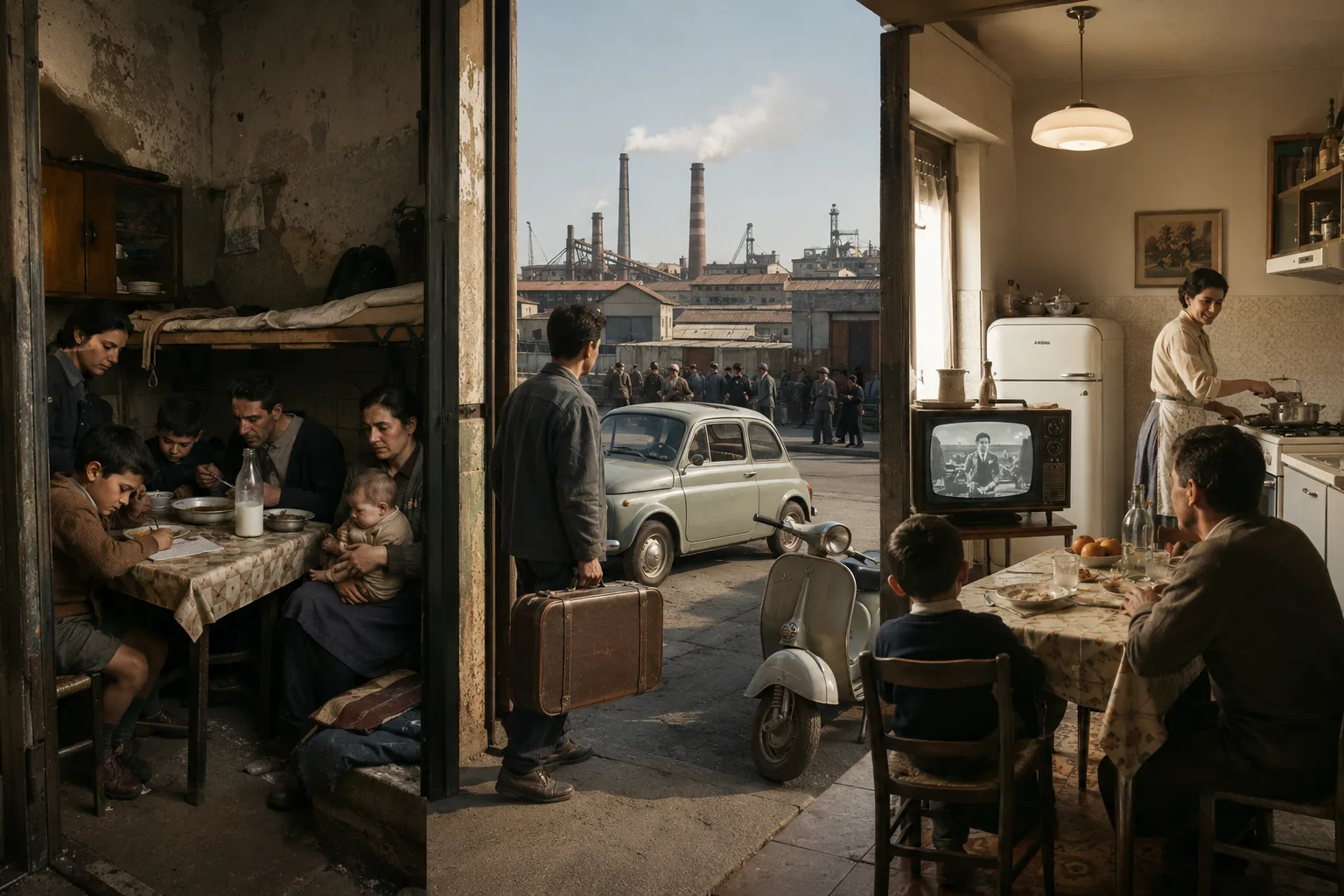
A cramped kitchen, a sink shared on the landing, one room that becomes the parents’ and children’s bedroom at night: for many Italian families in 1950, the war had not ended in any practical sense. Bombing had damaged factories, railways and homes; unemployment was still high; the countryside held more people than the land could support. In the outskirts of large cities, in mountain districts and across much of the South, poverty entered through the absence of running water and electricity, through inadequate food and unaffordable rent.
The parliamentary inquiry into poverty, concluded in 1953, recorded a country that may now feel remote but belongs to the recent history of Italian families. More than 12 million people, roughly a quarter of the population, lived in poverty. About 230,000 households were in cellars, attics or storerooms; a further 90,000 lived in shanties made of corrugated metal. The regional gap was stark: disadvantaged households accounted for 5.8 per cent of the total in the North, 15.6 per cent in the Centre and 50.2 per cent in the South. [1]
Another Italy existed alongside this hardship. In the Turin–Milan–Genoa triangle there were already engineering, steel, chemical and textile firms, together with skilled workers, rail connections, ports, banks and a long industrial tradition. Fiat, Pirelli, Olivetti and Ansaldo did not come into being during the boom. The boom enlarged their scale, production capacity and influence on the country’s daily life.
The distance between a Turin flat with an indoor bathroom and a rural home without running water conveys the starting point. Italy did not emerge from the war as a blank page. It had industrial resources concentrated in a few places, but they coexisted with widespread deprivation and territorial inequalities that national unification had never removed. The economic miracle would transform the country’s material life at great speed without fully resolving that contradiction. [1]
The name of the miracle
“Economic miracle” is an effective phrase because it conveys the sense of a sprint. From the first half of the 1950s to 1963, the Italian economy expanded production, exports, investment and employment at a pace few would have predicted immediately after the war. Within a short time, Italy shifted from an economy still strongly tied to agriculture to one of the leading manufacturing powers of the West.
The label becomes misleading when it suggests that growth appeared by itself. It emerged from a precise historical conjunction: post-war reconstruction, plentiful labour, public investment, firms ready to expand, relatively low wages, opening markets and the vigorous growth of Western Europe. Between 1950 and 1970, international trade enjoyed an especially favourable phase and Western European countries recorded average GDP growth of 5.5 per cent. Italy entered that cycle by moving away from its old protectionism and modernising its productive base. [1]
The pace of change appeared in statistics and, before long, in ordinary routines. In 1951 a refrigerator was uncommon; by 1967 Italian firms were producing more than three million a year. Industrial output doubled between 1951 and 1963. Exports rose at an annual rate of 12 per cent, above the Western European average. Italian goods crossing the border were no longer chiefly textiles and foodstuffs: appliances, engineering products, chemicals, cars and other consumer goods took their place. [1]
The boom altered the scale of the Italian economy. Its rewards, however, did not arrive automatically or evenly. A Fiat 600 might embody a young couple’s hopes, while the worker who built it faced demanding shifts and modest pay. A new plant could offer wages and services, but it could also bring hurriedly built suburbs, commuting and family separation. That tension runs through the whole story of the miracle.
Dollars and Europe
The Marshall Plan mattered, but it does not explain the boom on its own. Between 1948 and 1952, Italy received around 1.4 billion dollars through the European Recovery Program. The resources helped complete reconstruction and support transport, farming, public works and industry. They came in the form of money, raw materials, machinery and the ability to import what the country could not yet produce in sufficient quantities. [1]
The United States had clear political and economic interests. Rebuilding Europe created outlets for American goods and reinforced the Western bloc during the Cold War. After the election of 18 April 1948, Italy placed itself firmly in that camp. The choice brought capital and international relationships, while also involving a clear geopolitical alignment. The Marshall Plan was a lever within a wider settlement, not a magic wand brought in from abroad. [2]
European integration was the second lever. Italy signed the Treaty establishing the European Coal and Steel Community in 1951 alongside France, West Germany, Belgium, the Netherlands and Luxembourg. The Treaties of Rome of 1957 established the European Economic Community, which came into force on 1 January 1958. Coal, steel, goods and capital began to circulate within a larger economic space. For a country that needed to sell beyond its borders, that shift mattered as much as the growth of domestic demand. [3]
Italian production found markets for cars, typewriters, engineering goods, chemicals, textiles and domestic appliances. Between 1960 and 1965, the share of Italian exports going to the other five founding members of the EEC rose from 29 to 40.2 per cent. Italy did not become more industrial merely because Italians bought more. Its competitiveness grew because it entered a European network that rewarded productive capacity, prices and speed of delivery. [1]
The State and industry
The miracle is often told through private names: Fiat, Olivetti, Pirelli, Candy and Ignis. They matter, but they show only part of the picture. Italy during the boom had a mixed economy. The State owned or controlled businesses that were decisive in steel, energy, telecommunications, transport and infrastructure.
IRI, created in 1933 during the banking crisis, continued after the war and became a central tool of industrial policy. Through Finsider and Ilva, it helped provide the steel required for cars, washing machines, refrigerators, pipes, ports and major industrial sites. A new steelworks was built at Cornigliano and the large plant at Taranto opened in 1961. Steel gave shape to the goods of consumer society, as well as to the networks that moved them. [1]
ENI, founded in 1953 under Enrico Mattei, performed a comparable task in energy. The discovery and use of methane in the Po Valley provided an alternative to coal and supplied factories, gas networks and new domestic consumption. Mattei turned ENI into a group active in hydrocarbon exploration, fuel distribution, chemicals and fertilisers. In 1962, IRI and ENI together employed more than 350,000 people. [1]
The State also invested in infrastructure. The Romita law of 1955 entrusted IRI with planning, building and operating much of the new motorway system. Work on the Autostrada del Sole began in 1957. It was more than a road: it linked industrial areas, markets, ports, seaside resorts and growing cities. Between 1945 and 1970 Italy’s road network grew from 173,604 to 285,799 kilometres. The cost of that choice was also felt on the railways, which lost priority and investment. [1]
Objects of prosperity
The economic miracle entered homes as objects. A washing machine released hours of domestic labour; a refrigerator changed food shopping and storage; the telephone shortened distance; television opened a window onto an Italy previously known mainly through newspapers, radio and the stories of relatives. Prosperity did not arrive as a GDP figure. It appeared in kitchens, courtyards, garages and shop windows.
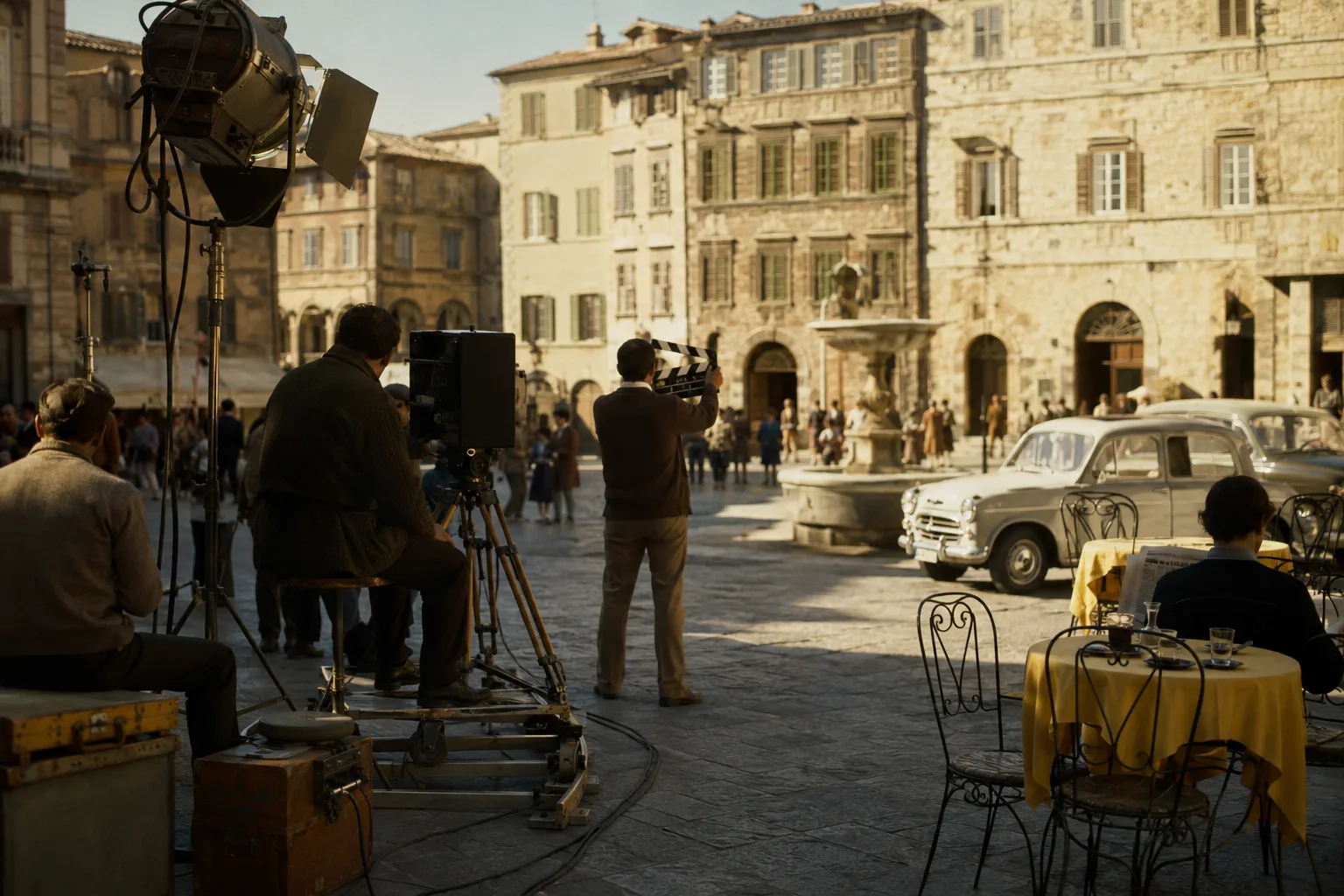
Mobility had a particular place. The Fiat 600, launched in 1955, and the Nuova 500 of 1957 placed car ownership within the imaginable reach of many households. They remained demanding purchases: in 1957 the 500 cost the equivalent of about ten monthly salaries for a white-collar employee and thirteen for a manual worker. That sacrifice says much about the desire for a car. Independent travel meant Sunday trips to the coast, visits to distant relatives, job searches beyond one’s town and a loosening of Italy’s old distances. [1]
The Vespa had anticipated the change. On 28 April 1956, the millionth example left the Piaggio assembly line in Pontedera. Ten years earlier the scooter had been an uncertain novelty; by the mid-1950s it had become a mass means of transport. Piaggio offered a vehicle cheaper and nimbler than a car, suited to cities still made of narrow streets and to roads that were rapidly changing. [4]
Consumer society brought freedom and fresh inequalities at the same time. Some families bought their first car; others watched television in a café because a set cost too much. Opportunities widened, but on very different schedules according to income, birthplace and type of work. Household consumption rose by more than 5 per cent annually during the boom years, yet the lives behind the average remained far apart. [5]
The suitcase and the assembly line
The human face of the boom is often someone leaving home. It may be a young man from Calabria carrying a cardboard suitcase, a Venetian family leaving the mountains, a farm labourer from Puglia travelling to Turin, or a young Sicilian woman joining relatives in Milan. The alarm rings early; the tram heads towards the factory; the day follows the rhythm of the assembly line. In the evening, people return to a rented room, a hostel or a flat shared with others. Part of the wage is sent home.
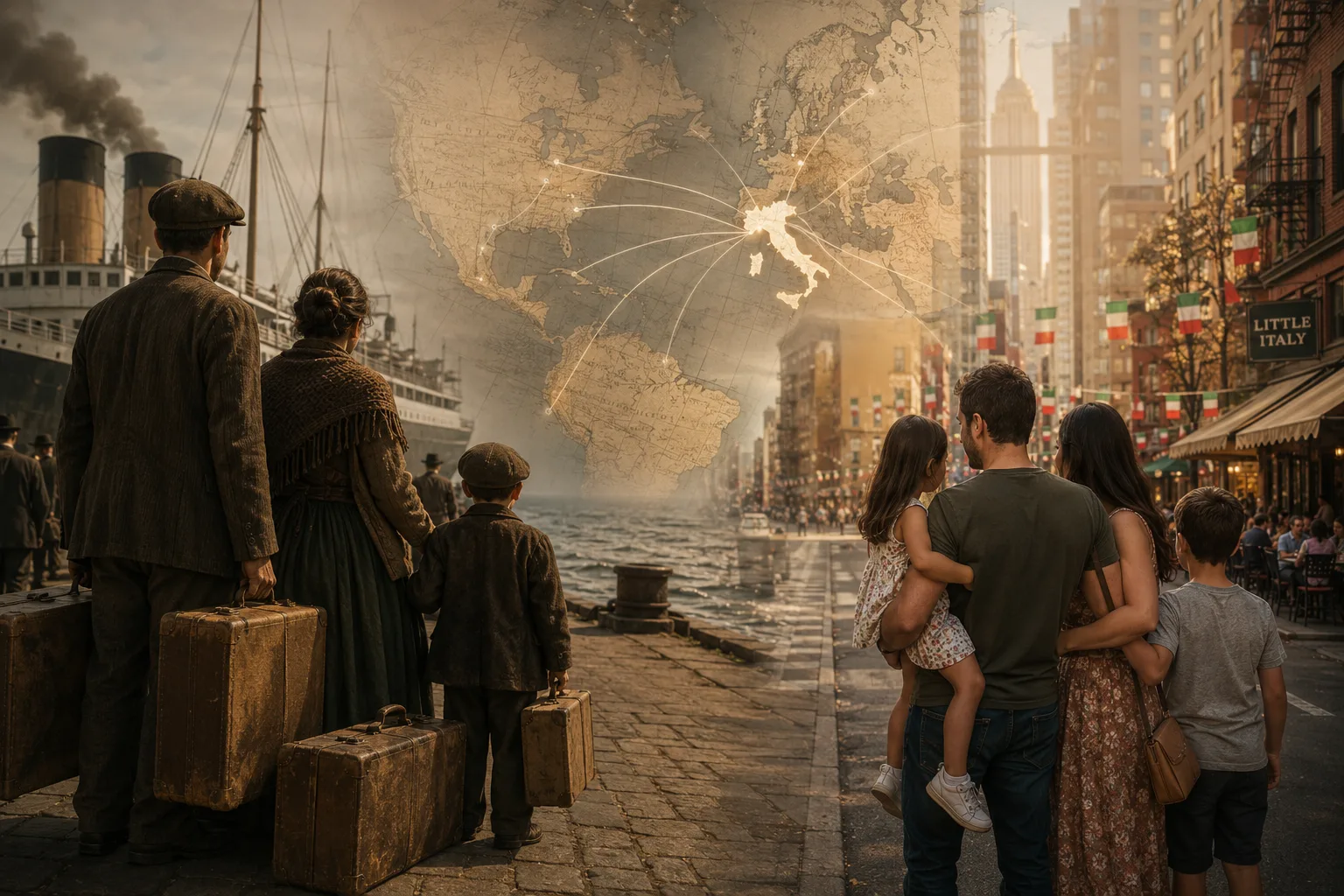
Between 1955 and 1970 there were around 25 million changes of residence. Seventy per cent of those moving left villages and small rural towns for places close to major cities and factories. Milan, Turin and Genoa drew workers; Rome and industrial areas in Lazio did too. Mountain districts, the Po delta, many Apennine villages and wide areas of the South lost young people, labour and the ability to renew themselves. [1]
The so-called Treni del Sole, the “Sun Trains”, connected southern towns with the industrial North. The name has a film-like glow, but the journey often involved a painful separation. Those who left found wages higher than anything available in the countryside and the prospect of steady work. They also encountered notices that read “southerners need not apply”, distrust of accents and dialects, overcrowded accommodation and an urban environment that was hard to decipher. In many northern schools, children newly arrived from the South were put back a year or two because they did not command the Italian required by teachers. [1]
These migrations were not a side note to modernisation. Factories expanded because they found labour; cities expanded because they absorbed it; families left behind lived on remittances. Italian industrialisation therefore had a precise geography: the North attracted, the South and countryside supplied people. The result was a meeting among Italians who often knew little of one another, even though they had lived in the same state for almost a century.
The South during the boom
The Mezzogiorno did not stand still during the boom. In 1950 the Cassa per il Mezzogiorno, a public fund for southern development, was established to finance exceptional public works and encourage economic and social progress in southern Italy. Roads, water systems, land reclamation, electricity networks and industrial centres changed many places. Land reform also tried to address property relations in the countryside, where the question of land had carried weight for decades. [6]
Such measures improved material conditions that in many areas remained close to the realities of the immediate post-war period. Bringing drinking water and electricity to a village changes more than a statistic: it changes women’s work, children’s health, food storage and the possibility of opening a small business. Industrial centres brought employment and infrastructure, yet they often depended on public investment or on large groups based elsewhere.
The gap with the North persisted because the starting conditions were so different. The most intense industrial growth remained concentrated in the north-west and in certain areas of the centre and north. Many southerners contributed directly to Italian industrial success, but did so in Turin, Milan, Genoa, Brescia and the cities of the industrial belt. Their home regions lost younger people and, with them, skills and initiative.
The Cassa per il Mezzogiorno was neither a total failure nor a definitive answer to the southern question. It built works and encouraged investment. It did not everywhere create a self-sustaining industrial fabric. The miracle thus revealed one of its hardest features to tell: Italy grew as a country, while growth proceeded at unequal speeds. [6]
Wages and conflict
Production rose faster than wages. Between 1951 and 1963, according to Treccani’s reconstruction, output increased by 95 per cent and profits by 86 per cent, while workers’ purchasing power initially remained almost still. The average workday reached ten hours, and twelve in some industries. The competitive price of Italian goods also rested on a large, disciplined and poorly paid workforce. [1]
Inside a modern factory, daily life could be punishing. Noise, heat, repetitive rhythms, inadequate safety measures and workplace surveillance formed the other side of industrial efficiency. Accidents were frequent. Treccani cites data from the INA indicating an average of about 4,600 deaths at work a year during the boom. The material progress of households coexisted with risks that would now appear unacceptable. [1]
Social conflict did not vanish with refrigerators and cars. In 1962, workers at Fiat, Lancia and Michelin went on strike in Turin for pay rises, holidays and shorter working hours. The days of Piazza Statuto showed that the new working class, made up largely of young migrants from the South, would no longer passively accept factory conditions. The struggles of the 1960s prepared later changes in collective agreements, safety and workers’ rights. [1]
The miracle improved Italian lives, but neither in the same way nor at the same time. For some it arrived with a first washing machine; for others with a secure contract; for others it remained a promise glimpsed in a shop window or a television advertisement. That difference belongs to the story, not to a footnote.
A country on screen
Regular Rai television broadcasts began on 3 January 1954. By the end of that year television reached 58 per cent of the population; in 1961 it reached 97 per cent of Italians. Sets were expensive, and many people watched programmes in cafés, clubs or the homes of better-off neighbours. Television was at once a technology, a collective ritual and an informal school of national language. [7]
Lascia o raddoppia?, Carosello, the news, variety-show songs and advertising brought images of Rome, Milan, Naples, Turin and unknown villages into the same evenings. Rai did not erase dialects, local differences or social distance. It did, however, circulate a common Italian and a shared repertoire of desires: the new kitchen, the better detergent, the car, the holiday, the domestic appliance, the modern flat.
In 1961, as Italy marked the centenary of national unification, the country seemed closer partly because of this shared imagery. Factories had connected people and goods; television connected words, faces and aspirations. A worker newly arrived in Turin could recognise on Carosello the same product advertised in the bar of the village he had left. That common language had tangible power, even when it sold dreams that many could not attain.
Television turned consumption into narrative. A refrigerator was no longer simply a machine for keeping food fresh: it became a sign of an orderly, modern and desirable home. Advertising did not invent consumer society by itself, but it gave that society images, words and family models. [7]
The pace slows
The most intense phase of the boom began to slow in 1963–64. Domestic demand was rising, imports were increasing, wage tensions were becoming sharper and the system was showing the imbalances accumulated in earlier years. The first major post-war recession marked the end of the most accelerated phase of growth, without undoing the industrialisation already achieved. [8]
The oil shocks of the 1970s finally ended the long favourable cycle that had begun after the war. Energy became more expensive, international competition changed and firms had to confront new markets and new technologies. Questions that the boom had made more visible remained open: the North–South divide, the suburbs, the weight of large industry, weak public services, workplace safety and the distribution of wealth. [1]
Italy did not become an industrial power through a spell. It arrived there through investment, labour, private enterprise, public industry, Europe, international aid and personal sacrifice. The Fiat 500 parked beneath a new block of flats, the television glowing in a café, the Vespa leaving Pontedera and the night train to Turin all belong to the same history.
The miracle left a country wealthier, more urban, more mobile and more connected. It also left unresolved questions. In 1970, when Italy already had motorways, exporting industries and millions of cars, many of the communities from which the workers had departed were still losing population. That image perhaps captures the boom best: growth capable of changing everything, without managing to distribute everything equally.
Bibliography
Discussion
Join discussion!
There are already 0 comments on this article in the forum.