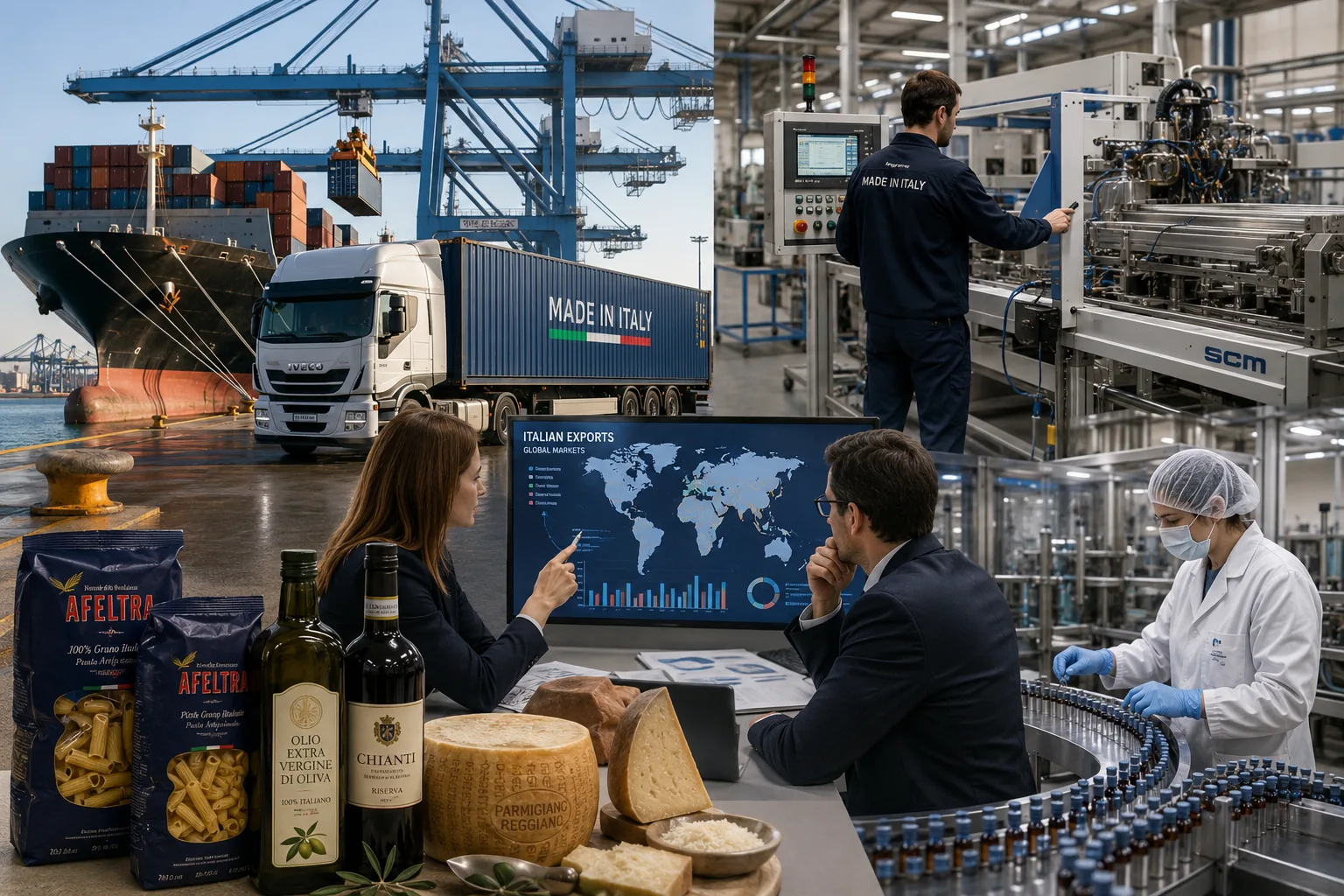
These figures tell of something more than a good year. Italy keeps producing goods that are in demand across many markets and, despite high energy costs, Asian competition, trade wars and a European slowdown, holds a prominent position in world trade: in 2025 it ranked fifth among goods exporters and ninth among importers. Much of the export total, moreover, concerns goods the end consumer never sees: industrial components, machinery, intermediate goods, professional equipment, pharmaceuticals, chemical products and technologies. Behind the aggregate figure are thousands of firms, often small and medium-sized, embedded in highly complex international supply chains. [2][3]
Machinery, pharmaceuticals, food: the true face of foreign sales
When people think of Italy abroad, fashion, wine, pasta, sports cars and designer furniture spring to mind. These are real and important sectors, but they account for less than half of export value. The bulk of Italy's presence on international markets rests on advanced manufacturing: machinery, industrial equipment, metal products, chemicals, pharmaceuticals, precision mechanics, specialised electronics and transport equipment. In many of these areas Italy competes on price less aggressively than China or Turkey, but wins on customisation, reliability, technical expertise, the ability to adapt products to customer requirements and after-sales support. [3]
The 2025 data show clearly what drove growth. Pharmaceutical, medicinal-chemical and botanical articles rose by 28.5%; basic metals and metal products, excluding machinery and equipment, by 9.8%; transport equipment other than motor vehicles by 11.6%; food products, beverages and tobacco by 4.3%. [1] Italian pharmaceuticals operate in high-value global chains and benefit from multinational groups, advanced production sites, expertise in active ingredients and contract manufacturing. Metalworking and metallurgy remain crucial because Italian components, plant and materials feed factories, infrastructure and production lines in many countries. These are exports invisible to the general public, but decisive for trade balances. One example clarifies the point. Italy's packaging-machinery companies, about 300 according to UCIMA estimates, together cover over 20% of the world market for packaging machines: a segment little known outside the industry, yet worth roughly 9 billion euros in annual exports. [3] The same holds for woodworking machinery, where Italy ranks among the world's top three producers, or ceramic machinery, where Sassuolo leads global sector technology. These are niches that enter the factories of half the world, even if the end consumer has never heard of them.
The specialisation that keeps Italy competitive
Machinery remains one of Italy's great specialisations. Beyond large-scale plant, Italy excels in packaging machines, food-processing equipment, textile, ceramic, wood- and metalworking machinery, plastics and pharmaceutical machinery, besides countless niche products. These are goods that require design, maintenance, spare parts, training and ongoing customer relations, and for that reason create commercial bonds more durable than a one-off consumer sale. In Mercosur markets, for instance, machinery accounted for 33.4% of Italian exports to the area in 2025, ahead of transport equipment, pharmaceuticals and chemicals. [2]
The food and drink sector also deserves attention. In 2024 food products, beverages and tobacco generated nearly 60 billion euros in exports, about 9.6% of total goods sold abroad. [3] The sector's strength stems from the reputation of Italian cuisine, designations of origin, perceived quality and the capacity to sell an experience alongside the product. Success brings its own problems, though: imitations, Italian-sounding knock-offs, counterfeiting and price competition. Protecting the value of Made in Italy therefore requires trademark protection, supply-chain control, credible communication and a stable commercial presence in foreign markets. [3]
The sector has, it should be said, proved resilient. Products with a designation of origin (PDO, PGI, TSG) represent a growing share of food exports, because they offer foreign buyers a guarantee of provenance and authenticity that is hard to replicate. Cheeses, cured meats, extra-virgin olive oil, balsamic vinegar and denomination wines command higher prices than anonymous competitors and, in many cases, growing volumes even when the market slows. [3] The question of distribution remains open, however: most Italian food exports pass through large foreign retail chains, which decide shelf space, pricing and communication. Companies that manage to build a direct relationship with the end consumer — through flagship stores, e-commerce or partnerships with Italian restaurants abroad — achieve markedly higher margins and visibility.
Districts, supply chains and production flexibility
The strength of Italian exports rests on a fragmented but highly specialised fabric: industrial districts, regional supply chains, evolved family businesses, mid-sized firms with deep international reach and large groups that often work together, rather than revolving around a single national champion as happens in France or Germany. The model has clear limits: smaller firms have less capital, less investment capacity and greater difficulty with red tape, international marketing, certifications or disputes. But it brings one decisive advantage: flexibility. An Italian company can modify a production line, adapt a component, manufacture a limited run, sort out a technical problem quickly or offer a near-bespoke solution to a foreign customer. [3]
In many sectors an Italian product is chosen not because it costs less, but because it solves a problem better. This holds for automatic machines, industrial components, precision mechanics, bespoke furniture, certain biomedical products and luxury goods. Low-cost competition bites hardest when the product is standardised; it matters far less when expertise, support, design, speed of modification and long-term reliability count. Geography plays a role too. The North still concentrates the larger share of exports, but in the first quarter of 2026 the South and Islands grew by 13.1% and the Centre by 7.2%, according to Istat data on regional exports. It is an encouraging sign: the capacity to sell abroad is developing outside the traditional industrial heartlands too, wherever adequate infrastructure, skills and efficient logistics exist. [3][5]
Europe, the United States and markets to secure
The European Union remains Italy's natural commercial space: proximity, the single market, shared rules and integrated production chains make it indispensable. In 2025 Germany absorbed 11.4% of Italian goods exports, the United States 10.8%, France 10.2%, Spain 5.9% and Switzerland 5.4%. [2] Europe therefore remains central, but the weight of the United States is now close to that of Germany and France. The American market buys pharmaceuticals, machinery, fashion, furniture, premium food products, transport equipment and luxury goods; in 2025 Italian exports to the USA grew by 7.2%, while Germany, France and Spain all recorded a decline on that same market. [2]
Among the large European economies, Italy is today the most exposed to the United States on the export side. Tariffs, dollar fluctuations, new trade rules or shifts in industrial policy therefore weigh more heavily than elsewhere. Istat estimates that increases in effective tariff rates had negative but contained effects on Italian exports in 2025, with a varied impact across products. [2] Diversifying, in this context, means strengthening the presence in India, Southeast Asia, Latin America, the Gulf states and Africa, accepting that broader opportunities carry greater commercial, financial and geopolitical risks. Italy's plan for extra-EU markets points precisely in this direction. [6]
ICE, SACE, SIMEST and the Farnesina: the public network behind the firms
Exporting takes far more than a good product: you need to understand the market, find reliable contacts, grasp local regulations and manage customs, contracts, payments, insurance, certifications and political risks. Italy has a public network that supports internationalisation, though smaller firms often know only part of it. The Ministry of Foreign Affairs and International Cooperation, commonly known as the Farnesina, coordinates economic diplomacy together with the Ministry of Enterprises and Made in Italy, the Ministry of Economy and other interested administrations. The Cabina di Regia for internationalisation sets the strategic direction; embassies, consulates, commercial offices and economic observatories provide information, contacts and support in individual countries. [7][10]
ICE-Agency promotes Italian firms abroad through trade fairs, Italian pavilions, collective stands, B2B meetings, trade missions, training, market analysis, e-commerce and sector promotion. Its network of foreign offices is especially useful where going it alone would be difficult. SACE helps manage risk through credit insurance, guarantees and market assessments; its Export Map 2026 analyses opportunities and risks in around 200 countries. [7][8] SIMEST completes the picture with soft loans for e-commerce, trade fairs, market entry and consolidation abroad, digitalisation, sustainability and supply-chain strengthening. For an SME, the difference between a one-off export and a stable foreign presence often hinges on the ability to finance catalogues, certifications, sales staff, technical support, logistics, local marketing and longer payment cycles. [9]
Open challenges and the real value of exports
Italian exports face concrete problems. Energy costs remain high, especially in metalworking, ceramics, chemicals, glass and paper; many firms are too small to tackle complex international investments on their own; ports, railways, intermodal connections and administrative procedures can push up costs and lead times. [2][8] There is also the gap in advanced services. Italy exports manufactured goods very successfully, but still has room to grow in ICT, intellectual property, business services and digital. In 2024 the services balance was positive mainly for travel and contract processing, but negative in transport, ICT, intellectual property and other high-productivity services. [2] This is a significant constraint, because global trade in services grows faster than trade in goods, and countries that fail to close the gap risk losing share in overall value added. For Italy, selling a machine can no longer be the end of the commercial relationship, but the beginning: the software that runs it, the data it produces, remote support and operator training have already become part of the package that foreign customers expect.
The most recent data confirm the system is holding up, but also indicate where to pay attention. According to Istat, in April 2026 exports maintained a positive trend, albeit with marked differences across sectors and geographical areas. [4] Future competitiveness will depend increasingly on the ability to sell services around products: predictive maintenance, software, remote support, digital training, traceability, e-commerce and direct customer relationships. SACE forecasts that after the near-5% growth in global goods trade in 2025, the 2026–2028 period will see a more moderate average expansion of around 2.3%, against a backdrop of geopolitical tensions, fragmented supply chains and the risk of new tariffs. [8] Italian exports represent a capacity built on technical skills, districts, reputation, flexibility and products that are hard to substitute. Preserving it requires investment, infrastructure, innovation and a coherent international strategy. [1][3]








Discussion
Join discussion!
There are already 0 comments on this article in the forum.