A drum machine, a distant voice, a night that could be anywhere
A steady electronic beat begins, almost geometric in its precision. A synthetic bass line comes in, driving yet melancholy. Then a voice sings in English about love, telephones, lit-up cities and desires too large for a single night. Whether the accent is Italian, German, French or hard to place hardly matters: the record already seems designed to cross borders.
It is one of the most recognisable sound images of 1980s Europe. We now call it Italo disco, a name that instantly suggests bright synths, immediate choruses, twelve-inch singles, futuristic sleeves and dance floors. But reducing it to a dose of neon nostalgia and digital retro chic would miss the point.
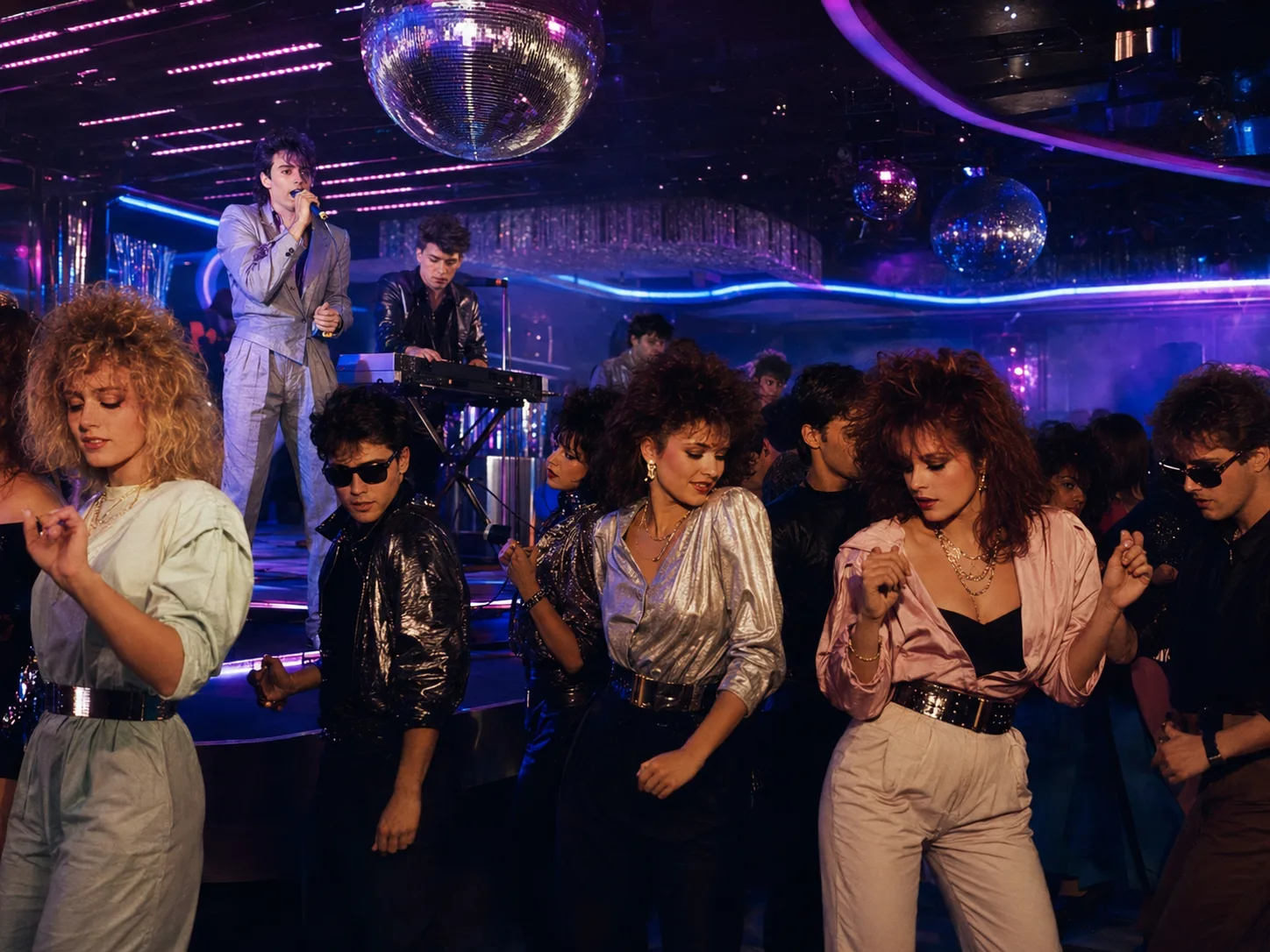
Before anything else, Italo disco was a network of productions. It grew out of the meeting of nightclubs, increasingly accessible music technology, small studios, fast-moving labels, DJs, tourist circuits and a European market far more connected than it may look when the decade is viewed only through national television.
Its history also contains a paradox. Much of this music was made in Italy or by Italian producers, yet the name that identifies it today took hold above all abroad, through compilations, licensing, record shops, specialist radio and European distribution. The songs came first. The label arrived later and, over time, became a cultural identity.
What exactly is Italo disco?
“Italo disco” does not describe a tightly organised movement with a manifesto, one city of origin or a group of artists who all identified with the same name. In the 1980s, many records now placed in this category were more broadly marketed as club music, electro, Eurodisco, synth-pop, Hi-NRG, post-disco or simply dance.
Recent scholarship recommends using the term with care. Guglielmo Bottin has shown that italodisco is not only the name of a historical repertoire but also a label whose meaning has changed over time: it can refer to Italian productions from the 1980s, a retro imaginary created later, a deliberately kitsch taste, or new tracks that imitate the sound of an imagined past [1].
The ZYX compilations released in 1983 were crucial in making the term recognisable and in gathering Italian records for the German and wider European market. Yet it would be too definite to say that Bernhard Mikulski single-handedly and unquestionably invented the term. Earlier uses of the idea of an Italian disco existed, and the entire history of that word cannot be assigned with absolute certainty to one person.
It therefore makes sense to distinguish four levels. The first is music actually produced in Italy or by Italian producers. The second is the commercial brand used to sell and organise that repertoire. The third is the imaginary reconstructed later by collectors, DJs and digital platforms. The fourth is the contemporary revival, which often uses “Italo disco” much more broadly than the historical reality warrants.
That distinction does not make the genre less compelling. It makes it more interesting: Italo disco was not a sealed box, but a music that also built its identity through those who catalogued it, distributed it and brought it back into view.
From nightclub to studio: less orchestra, more machines
Italo disco did not appear out of nowhere. It followed the great period of American disco in the 1970s, music shaped in clubs and around the figure of the DJ. Treccani notes that disco established itself through pre-recorded and mixed tracks able to create an almost uninterrupted flow of sound in the club [2].
In the 1980s that logic did not disappear; its instruments changed. Disco orchestras, with their strings, brass sections and large ensembles, increasingly gave way to synthesizers, drum machines, sequencers, programmable keyboards and smaller studios. A complete band was no longer necessary to build a dance-floor record. Technical skill, melodic instinct, a rhythm machine, a few keyboards and the ability to imagine the finished result could be enough.
Giorgio Moroder’s influence was decisive in this transition, although it would be inaccurate to call him an Italo disco artist in the strict sense. The South Tyrolean producer had already shown, through his international electronic work in the 1970s, that dance music could be built around synthetic pulses, repetition, precision and melodic tension.
Italo disco then absorbed elements from British and German synth-pop, new wave, American Hi-NRG, Eurodisco and Europe’s earliest electronic experiments. The outcome was not always uniform. Some records were romantic and melodic; others were mechanical, sensual, minimalist or frankly futuristic.
The key question is this: what happens when music made for dancing is entrusted no longer to a large band, but to keyboards, sequencers and a recording room? The sound changes, but the purpose does not. The music must still move the body. It simply does so now with instruments that seem to speak the language of the future.
Easy to recognise, hard to reduce to a formula
Italo disco has recurring features, but no formula explains all its records. It often uses a four-to-the-floor electronic beat, pulsing synthetic bass lines, bright or metallic keyboards, short melodies that lodge in the memory at once, and voices treated with reverb, chorus, overdubs or vocoder effects.
Arrangements were often longer than a conventional radio song. The twelve-inch was not simply a larger format to sell: it gave DJs room for mixing, repetition, the gradual entrance of elements and the building of anticipation. An extended version could dwell on a bass line, allow a rhythmic sequence to breathe, or repeat a vocal phrase until it became a collective gesture.
Many of these tracks seem straightforward because their pop structure is direct. But simplicity is not the same as shallowness. Their force depended on the balance between rhythm, synthetic timbre, melodic phrase and emotional tension. A bass line that was too heavy could smother a track. A melody that was too elaborate could make it less immediate. A voice pushed too far forward could take away the atmosphere.
Italo disco did not aim for symphonic complexity. It aimed to build, with a few elements, a sound world recognisable within seconds. That is why a romantic record such as Gazebo’s I Like Chopin and a harder track such as Klein & M.B.O.’s Dirty Talk can inhabit the same universe without resembling one another.
In the first case, synthetic romanticism takes the lead: an elegant, almost cinematic melancholy that uses Chopin’s name not to imitate classical music, but to evoke emotional refinement. In the second, a mechanical, sensual and minimalist tension appears, already looking towards house and the club electronics of the following years [3].
Imperfect English was not a flaw: it was a language of export
One of the most misunderstood aspects of Italo disco is its relationship with English. Many Italian and European artists sang pared-back lyrics, often with marked pronunciation and repeated formulas. Today this is sometimes treated ironically, as though imperfect English were evidence of weakness.
That reading is mistaken. This English was an aesthetic and commercial choice. It allowed a track to circulate more easily through Germany, France, Spain, Eastern Europe and international dance markets. It stopped a song from being tied to a single Italian region. It also created an abstract, international, romantic or futuristic space.
Those lyrics should not be judged by the standards of an Anglo-American song built on complex narratives and flawless idiom. In Italo disco, language often had a sonic function. Certain words needed to be immediate, singable and easily recognised: love, night, heart, radio, dream, danger, dance, fire.
An Italian title paired with English lyrics could become the ideal formula for exporting an idea of Italy. Ryan Paris’s Dolce Vita is a clear example: its title carries an Italian imaginary, while the song chooses an international language and a dance structure intended to travel beyond national borders. The single was released in Italy in 1983 and distributed in other European markets as well [4].
When Italian music chooses English, does it stop being Italian? In Italo disco, almost the opposite happens. English does not erase the origin; it makes it exportable.
Small labels, large circuits: an agile industry
Italo disco was not built only by artists recognisable from their sleeves. Behind many singles were producers, arrangers, programmers, sound engineers, vocalists, photographers, graphic designers, DJs, printers and small studios. The performer’s name was often a persona, a project or an abbreviation rather than a traditional singer-songwriter identity.
Labels such as Discomagic, Memory Records, X-Energy, Merak, American Disco, Sensation and Crash worked within a fast-moving system. The dance market required frequent new releases, extended versions, remixes, instrumental B-sides and singles capable of developing an independent life in clubs.
This agile structure was a strength. The long lead times of the major record industry were not always needed. A producer could spot a trend, make a track, record a voice, complete a club mix and place it within an international distribution circuit much faster than traditional pop allowed.
ZYX was particularly important in connecting this repertoire with the German and wider European market. Its archive and catalogue still contain a strong presence of compilations devoted to Italo disco, Eurodisco and 1980s dance repertory [5]. Yet it is important to remember that ZYX does not represent all of Italo disco: it represents a decisive part of its circulation, archiving and commercial construction.
Italy in the 1980s exported more than famous singers. It also exported studios, production methods, remixes, graphic concepts, melodic formulas and songs designed for the European dance floor. Italo disco was a small creative industry able to move quickly between local and international spaces.
Not one city, but a geography of studios, clubs and distribution
To describe Italo disco as exclusively Milanese or exclusively Romagnol would be reductive. Milan and Lombardy were central to labels, studios, distribution, advertising and the record market. Bologna and Emilia-Romagna brought a strong culture of clubs, producers and electronic experimentation, as well as a connection with the Riviera.
Rimini and the Romagnol coast mattered not only for summer tourism, but for the role of discos, DJs and dance floors as places where music received an immediate test. Rome brought together studios, television, pop production and artists able to cross genres. Naples and southern Italy contributed through local productions, voices, melodic sensibilities and regional circuits.
Germany then became decisive in transforming that Italian network into a category recognisable to the European public. Compilations, licensing and distribution did something that did not always happen in the same way in Italy: they collected scattered records and presented them as part of one sound family.
Italo disco was therefore Italian, but also deeply European. A track could be recorded in Italy, have an English title, be distributed by a German label, appear on a compilation sold in France and become a cult object years later in Warsaw, Tokyo or Berlin.
A constellation of records: romanticism, electronic funk, robots and space
Giorgio Moroder is the indispensable predecessor. He should not automatically be placed inside Italo disco, but without his electronic revolution it is difficult to understand why, only a few years later, a repeated synthesizer bass line could sound so natural in international dance music.
With I Like Chopin, Gazebo reveals the elegant and melancholy side of the repertoire. Released in 1983, the track combines pop melody, electronics and a cosmopolitan nostalgia that feels designed for a nocturnal city rather than a precise geographical place [6].
Ryan Paris, with Dolce Vita, stages a different formula: an Italian title, an international voice, dance production and a lightness that becomes an exportable image of a sunlit, artificial Italy. It is not the everyday Italy of factories, politics or suburbs. It is an imagined Italy, ready for a European dance floor.
Kano’s I’m Ready shows a more porous boundary. Active as early as 1980, the project combined post-disco, electronic funk, synthesizers and treated voices. That sound belongs as much to the history of Italo disco as to the prehistory of house and international electronic dance music [7].
With Dirty Talk, Klein & M.B.O. demonstrate that Italo disco was not only about romantic choruses. Released in 1982, the track uses sparer pulses, electronic sensuality and an almost industrial attitude. It is one of the cases in which a genre label matters less than its historical function: showing how far ahead Italian dance could be of its popular image [3].
Alexander Robotnick’s Problèmes d’Amour represents another direction altogether. His project does not seek the big radio chorus but a more experimental, ironic and underground world. Released in 1983 on Fuzz Dance, the track brings a more abstract sensibility into the Italo disco universe, almost like that of an electronic laboratory [8].
Valerie Dore, Ken Laszlo, P. Lion, Savage, Koto, Fun Fun and Miko Mission should not be treated as names in a nostalgic list. Each helps reveal a different side of the constellation: the mysterious female voice, club romanticism, space disco, Hi-NRG energy, the pop chorus, the studio project and production designed for different markets.
Robots, love, radio and escape: the imagined electronic Italy
Italo disco lyrics often revolve around a handful of emotional territories: love, abandonment, night, seduction, telephone calls, radio, illuminated cities, robots, space, escape and the desire to be elsewhere.
This imaginary seems superficial only when viewed with snobbery. In the 1980s, synthesizers, home computers, video games, private television and new advertising imagery were changing the relationship with the future. Machines were no longer merely industrial objects: they became signs of possibility, style, speed and identity.
Italo disco often did not describe the real Italy in detail. It did not necessarily tell stories about work, politics or the outskirts of cities. It created an electronic, international and artificial version of the country: an Italy made of lights, cars, tourist resorts, discos, endless nights and promises of escape.
It is precisely this distance from realism that makes it interesting. A song does not have to tell us exactly where we are. It must make us feel that we might be anywhere: Milan, Rimini, Munich, Paris, Berlin or a city that exists only inside a synthesizer.
Why Italy underestimated it
For years, Italo disco was treated in Italy as minor, commercial, overly simple or even embarrassing music. Critics often preferred singer-songwriter rock, political song, jazz or pop considered more dignified. Music made for dancing was easily placed in a lower category.
Other factors weighed on it too: stripped-back lyrics, imperfect English, visual imagery that was sometimes deliberately kitsch, the central role of the single rather than the auteur album, and the fact that many successes seemed more important abroad than in Italy itself.
But music designed to sell a twelve-inch or work in a disco is not automatically poor in ideas, technique or cultural value. On the contrary, Italo disco demanded precise skills: programming machines, building a groove, recording a voice, balancing a synthetic sound, leaving room for the DJ and creating a chorus memorable at first hearing.
Its underestimation also comes from the difficulty of accepting that Italy could be, alongside the country of melodic song, opera and the singer-songwriter tradition, an efficient workshop for popular electronic production.
An ending that was not an ending: house, Eurobeat, Italo dance and synthwave
Italo disco did not suddenly vanish. From the second half of the 1980s into the early 1990s, its sound changed, sped up and fragmented. Some producers moved towards house; others towards Eurobeat, techno, Hi-NRG, Italo house and later Italo dance.
Italo house retained a club vocation but made groove and house piano more central. Eurobeat raised the speed, emphasis and international scale. Italo dance in the 1990s kept direct melodies, instant hooks and a strong radio appeal. Later, electroclash, nu-disco and synthwave recovered 1980s rhythms, timbres and images, often adding irony and retrospective awareness.
There is no need to force a perfect genealogy. Not all house comes from Italo disco, not all synthwave is its direct descendant, and not every track with an 1980s-style synth automatically belongs to this world. What remains is a vocabulary: electronic bass lines, simple melodies, broad choruses, dance-floor melancholy, a desire for the future and pleasure in artificial sound.
The revival: hearing the records or hearing an idea of the 1980s?
Italo disco’s rediscovery has passed through DJs, underground clubs, vinyl collectors, reissues, compilations, YouTube, Bandcamp, Discogs, online radio and nu-disco, electro and synthwave sets. The process has had a real merit: it has brought producers, vocalists, technicians and small catalogues that remained in the margins for years back into view.
But it also has a risk. The revival can turn Italo disco into a caricature made only of mirrored sunglasses, neon, smoke machines and algorithmic nostalgia. In this simplified version, every record becomes identical and the 1980s become one large theme park.
The useful question is therefore this: are we truly listening to those songs, with their differences, contradictions and industrial history? Or are we listening only to the contemporary idea we have of the 1980s?
The best answer is not to choose between archive and pleasure. We can dance to these records, enjoy their aesthetics and at the same time recognise that behind a synth were people, studios, linguistic choices, economic circuits and a musical Europe far less peripheral than people now imagine.
The Kolors and “Italodisco”: the past as a contemporary pop language
The conclusion to this story cannot be a nostalgic repetition of the past. It has to look at what happens when that sound vocabulary returns to today’s pop.
The Kolors’ Italodisco is not a philological reconstruction of historical Italo disco. It does not pretend to be a single released in 1983, nor can it be treated as a copy of 1980s studio projects. It is a contemporary pop song that takes up a series of now-recognisable signs: bright synths, a direct dance beat, an immediate chorus, nocturnal atmosphere, pop melancholy and a desire for escape.
The title openly declares the game. It does not offer a lesson in musical archaeology; it recalls a sound repertoire now recognisable even to listeners born long after the genre’s first season had ended. The song translates that vocabulary for radio, streaming, social platforms and a contemporary audience.
Its success was not merely nostalgic. According to FIMI, “Italodisco” spent eleven weeks at the top of the Italian chart, surpassed 220 million streams and achieved five platinum records in Italy, alongside recognition in other European markets [9].
This does not mean that every track with 1980s synths is Italo disco. It does mean that some ideas from that period continue to work: the electronic bass line, the chorus, the desire for night, the melancholy inside dance-floor energy and the feeling of being able to move elsewhere for three minutes.
Italo disco is not only an archive for collectors. It is a musical language that has changed name, audience and technology, yet has never entirely stopped seeking the same thing: to build, with a few machines, a voice and a melody, a future convincing enough to dance inside.
Bibliography







Discussion
Join discussion!
There are already 0 comments on this article in the forum.